
Choosing a workout split can feel more complicated than choosing the exercises themselves.
One person says Push Pull Legs (PPL) is the only sensible way to train. Another swears by the classic bro split, where Monday means chest and the rest of the week follows.
The truth is less dramatic.
Both can work. The better choice depends on how often you can train, how much weekly volume you need, how well you recover, and whether you can actually stick to the routine.
Research also suggests that the name of the split is not the main driver of muscle growth. When resistance-training volume is matched, different ways of organizing that volume can produce similar results.
So instead of asking, “Which split is the best?”
Ask:
“Which split fits my life well enough that I can train consistently and progress?”
What Is a PPL Split?
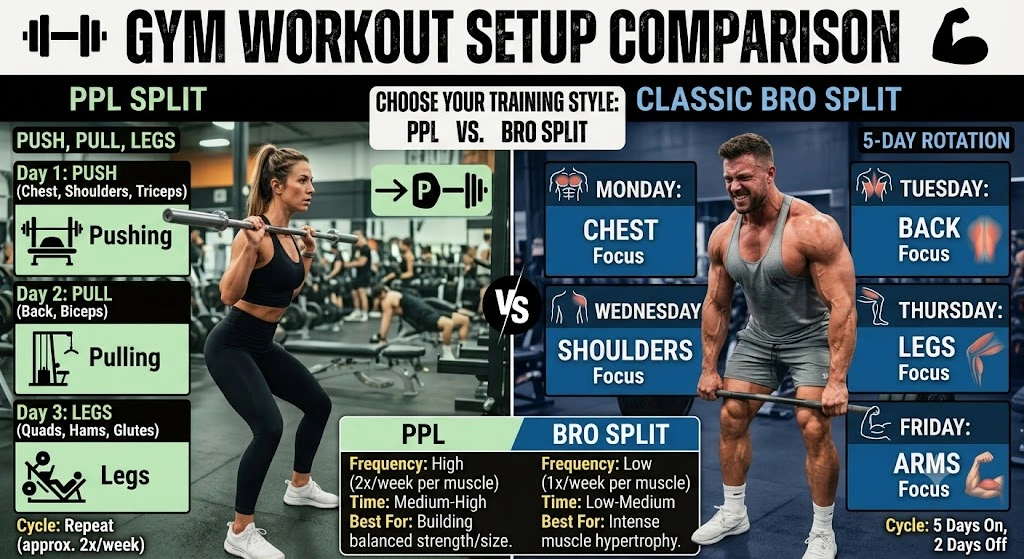
PPL stands for Push, Pull, Legs.
The idea is simple: exercises are grouped according to the main movement and muscles involved.
Push: chest, shoulders, and triceps
Pull: back, rear delts, and biceps
Legs: quads, hamstrings, glutes, and calves
A classic six-day version looks like this:
| Day | Workout |
|---|---|
| Monday | Push |
| Tuesday | Pull |
| Wednesday | Legs |
| Thursday | Push |
| Friday | Pull |
| Saturday | Legs |
| Sunday | Rest |
The big advantage is that each major muscle group gets trained twice during the week.
However, you do not have to train six days to use the PPL concept. A three-day version can simply rotate through Push, Pull,l and Legs, while a four- or five-day version can rotate sessions around your available days.
That flexibility is one reason PPL has become so popular.
What Is a Bro Split?
A traditional bro split usually gives each major muscle group its own day.
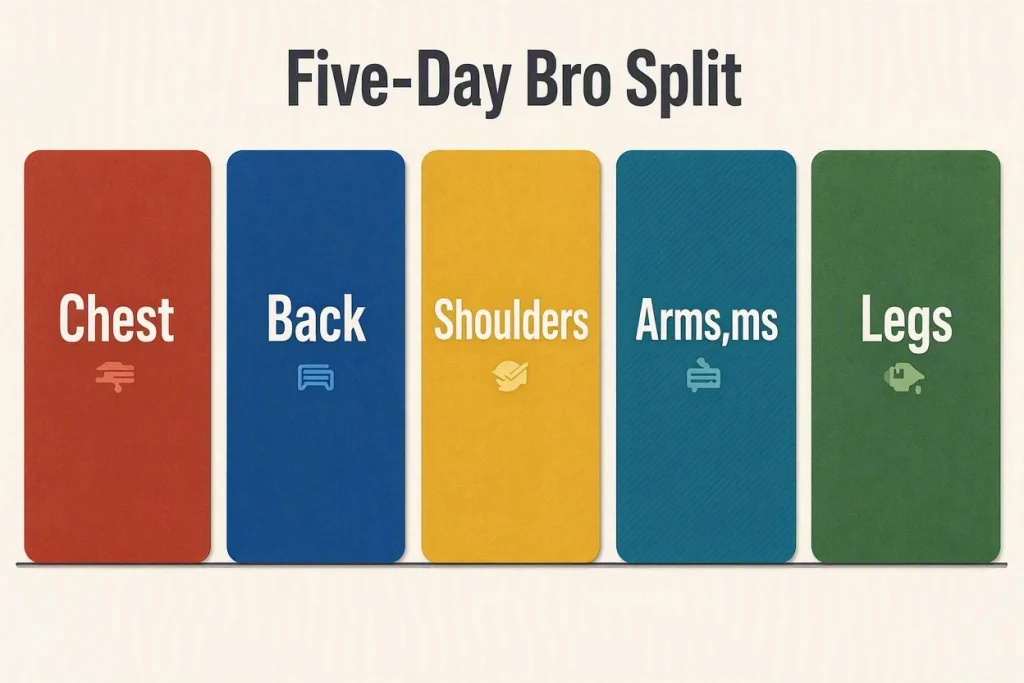
A common five-day example looks like this:
| Day | Workout |
|---|---|
| Monday | Chest |
| Tuesday | Back |
| Wednesday | Shoulders |
| Thursday | Arms |
| Friday | Legs |
| Saturday | Rest |
| Sunday | Rest |
Instead of spreading weekly work across multiple sessions, the bro split concentrates more work for a muscle into one workout.
That can make the sessions feel very focused.
You get a dedicated chest day. A dedicated back day. A dedicated arm day.
For some lifters, that simplicity is exactly what makes the routine enjoyable enough to follow consistently.
PPL vs Bro Split: What Is the Real Difference?
The biggest difference is how you distribute your training across the week.
| Factor | PPL | Bro Split |
|---|---|---|
| Typical frequency | Often 2× per muscle in 6-day version | Usually 1× per muscle |
| Typical days | 3–6+ | 4–6 |
| Session focus | Movement groups | Individual muscles |
| Weekly volume | Spread across sessions | More concentrated |
| Missed workout | Usually easier to recover from | Can leave one muscle waiting |
| Best feature | Flexible volume distribution | Simple, focused sessions |
The important word here is “typical.”
A PPL can be modified. A bro split can be modified too.
Therefore, the comparison should focus on the actual program rather than the label printed on your notebook.
Which Is Better for Muscle Growth?
This is where gym arguments usually become louder than the evidence.
Current research does not support the idea that simply choosing a particular split guarantees more muscle growth. A 2024 systematic review and meta-analysis found similar strength and hypertrophy outcomes between split and full-body routines when training volume was equated.
Training frequency can still matter for practical programming.
For example, spreading your weekly sets across two sessions can make it easier to maintain good performance instead of cramming a very large amount of work into one day. Research on training frequency has produced mixed findings depending on how total volume is handled, which is why frequency should be viewed as a programming tool rather than a magic muscle-building switch.
ACSM’s 2026 resistance-training guidance emphasizes consistency, matching the program to your goal, and training major muscle groups at least twice per week as a general starting point.
So, PPL has a practical advantage for many lifters because it can distribute training volume across the week more easily.
That does not make the bro split useless.
PPL vs Bro Split: Which One Fits Your Schedule?
This is probably the most important section of the entire article.
If You Can Train 6 Days a Week
PPL is the obvious fit.
A classic Push, Pull, Legs repeated twice gives every major muscle group two training exposures each week.
The schedule is straightforward, and weekly volume can be divided between two sessions instead of being crammed into one.
Best choice: PPL
If You Can Train 5 Days a Week
Things become more interesting.
A traditional bro split fits perfectly into five days.
However, a modified PPL can also work by rotating the sessions rather than trying to force a perfect Monday-to-Sunday pattern.
For example:
Monday: Push
Tuesday: Pull
Wednesday: Legs
Thursday: Rest
Friday: Push
Saturday: Pull
Sunday: Rest
The following week can start with Legs.
So you are not tied to the calendar.
Best choice: Slight advantage to a flexible PPL setup, but bro split is perfectly workable.
If You Can Train 4 Days a Week
Neither classic version is perfect.
A six-day PPL obviously does not fit.
A five-day bro split also does not fit comfortably.
At this point, an Upper/Lower routine may actually make more sense than either one because you can train the upper body and lower body twice per week.
Still, between the two options, a modified PPL can be adapted more easily than trying to maintain a traditional five-day bro split.
Best choice: Modified PPL, but consider Upper/Lower.
If You Can Train 3 Days a Week
A three-day PPL can work:
Monday: Push
Wednesday: Pull
Friday: Legs
The problem is frequency.
Each major muscle group is directly trained only once that week.
For someone training only three days, a full-body routine is often a more efficient use of those sessions because major muscle groups can be trained more frequently.
ACSM’s current guidance emphasizes regular training of the major muscle groups across the week rather than chasing complicated splits.
Best choice: Neither is ideal. Consider full body.
When Does a Bro Split Make Sense?
A bro split can make plenty of sense when you genuinely enjoy training that way.
Experienced lifters may also like the ability to dedicate a lot of attention to a particular muscle in one session.
For example, someone trying to bring up their chest or arms may enjoy having an entire workout focused around that area.
There is also a simple psychological benefit: the day’s goal is obvious.
Monday = Chest.
You know what you’re doing before you walk through the gym door.
The problem appears when the schedule becomes fragile.
Miss Monday and your chest workout may disappear for an entire week.
That is not ideal for someone whose work, college, travel,l or other responsibilities regularly interfere with training.
When Does PPL Make More Sense?
PPL is particularly useful when you want to spread your training across the week.
The movement-based structure also creates logical exercise groupings:
Push: pressing movements + triceps
Pull: rows/pulldowns + biceps
Legs: squats/hinges + lower-body work
Because related muscles are trained together, the structure can be easy to organize.
More importantly, the split can accommodate different schedules.
The classic six-day version is only one option. You can rotate Push, Pull,ll and Legs across the days you actually have available.
For someone still building their training foundation, our Beginner Strength Training Routine is a useful starting point before jumping into more complicated programming.
PPL vs Bro Split: What About Recovery?
Recovery depends on much more than the name of your split.
Total training volume, exercise selection, effort, sleep, nutrition, and individual recovery all matter.
ACSM’s 2026 position statement emphasizes keeping programs practical and sustainable rather than assuming advanced methods are automatically better.
A bro split can produce a lot of local fatigue during a single muscle-focused session.
Meanwhile, a high-frequency PPL routine can create more total training days and therefore requires you to manage your recovery across the week.
That means PPL is not automatically easier.
A six-day PPL can actually be demanding if every session is long and hard.
The best routine leaves you recovered enough to perform well in the next session.
What About Weekly Training Volume?
Volume matters more than the split’s name.
If you need a certain amount of productive work for a muscle, the split determines where you put those sets.
Imagine you want to perform 12 challenging sets for chest across the week.
A bro split might put most or all of them on Monday.
A PPL approach might divide the work across two push sessions.
The second setup can make those sets easier to distribute and potentially help maintain better performance across the workout.
Recent resistance-training research continues to examine how weekly set volume and frequency interact, rather than treating one magical number as universally optimal.
The Simple Decision: Which Split Should You Choose?
Use this quick guide.
| Your situation | Best starting choice |
|---|---|
| 3 days/week | Full body |
| 4 days/week | Upper/Lower |
| 5 days/week | Flexible PPL or Bro Split |
| 6 days/week | PPL |
| Love dedicated muscle days | Bro Split |
| Often miss random weekdays | Flexible PPL |
| Want to spread volume | PPL |
| Prefer simple, focused sessions | Bro Split |
The biggest mistake would be choosing a routine because someone on Instagram told you it is “the best.”
Your schedule already gives you a huge part of the answer.
Common Mistakes With Workout Splits
Changing Programs Too Often
A good program needs time to work.
Jumping from PPL to bro split to upper/lower every few weeks makes progression harder to evaluate.
Copying an Advanced Routine
A six-day bodybuilding routine may look impressive online, but that does not make it appropriate for everyone.
Ignoring Your Schedule
Theoretically perfect programming is useless if you keep missing sessions.
Chasing Frequency Without Managing Volume
Training a muscle more often does not automatically make the program better.
The weekly workload still needs to be manageable.
Forgetting Progressive Overload
A split is simply a way to organize your training.
Progress still comes from consistently challenging yourself over time.
For a deeper explanation, read Muscle Building Tips for Beginners.
FAQ About PPL vs Bro Split
Is PPL better than a bro split?
Not automatically. Both can build muscle when programmed well. The better option depends on your available training days, weekly volume, and ability to stay consistent.
Is PPL good for beginners?
It can work, but beginners do not necessarily need a six-day PPL routine. A simpler full-body or upper/lower routine can be easier to manage while learning the basics.
Can I do PPL 4 days a week?
Yes. You can rotate Push, Pull,l and Legs through your available days rather than trying to force the classic six-day schedule.
Is a bro split bad for natural lifters?
No. A bro split can still work for natural lifters. The important factors are productive weekly training, progression recoverye, recovery, and consistency.
Which split is best for muscle growth?
There is no single universally best split. Current evidence suggests that when training volume is appropriately matched, the split itself does not guarantee superior hypertrophy.
Can I change from bro split to PPL?
Yes. Changing your split is completely fine when your current routine no longer fits your goals or schedule.
What if I can only train 3 days a week?
A full-body routine is usually a more practical starting point because you can train the major muscle groups more frequently within those three sessions.
Final Takeaway
PPL vs bro split is not really a battle between “good” and “bad” training.
PPL is useful because it can spread training volume across the week and work especially well when you have five or six training days available.
A bro split is useful because it is simple, focused,sed and easy to understand. For an experienced lifter who enjoys dedicated muscle days and can reliably train five days per week, it can still be a perfectly workable approach.
The real winner is the routine that fits your schedule and gives you enough productive training to progress.
So choose the split you can actually follow.
Train consistently. Progress gradually. Recover properly.
The name of the split matters far less than what you do with it.