
You go to the gym, lift weights, get stronger for a while, and then suddenly the same weights stop feeling challenging.
So what do you do?
Add more weight?
Add more reps?
Do more sets?
This is where progressive overload comes in.
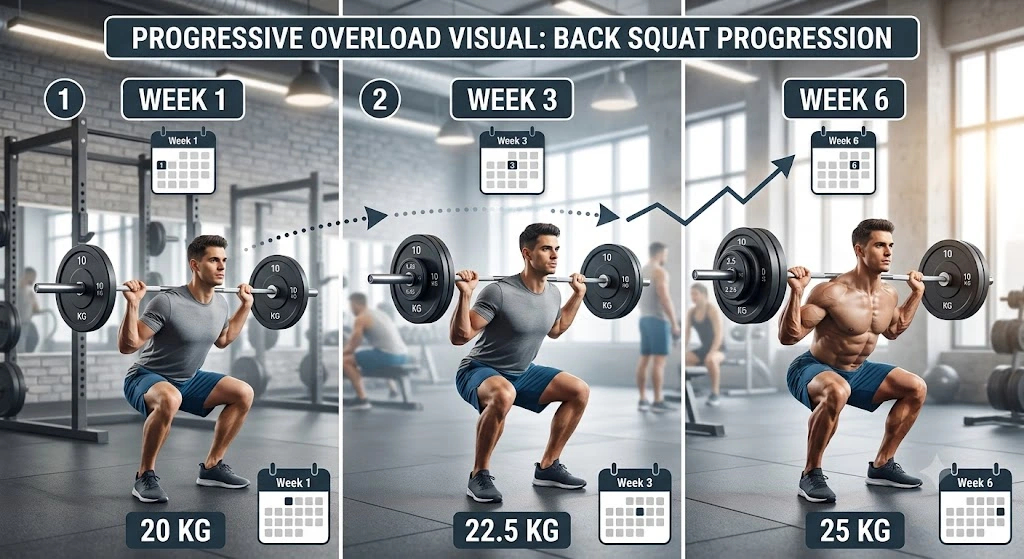
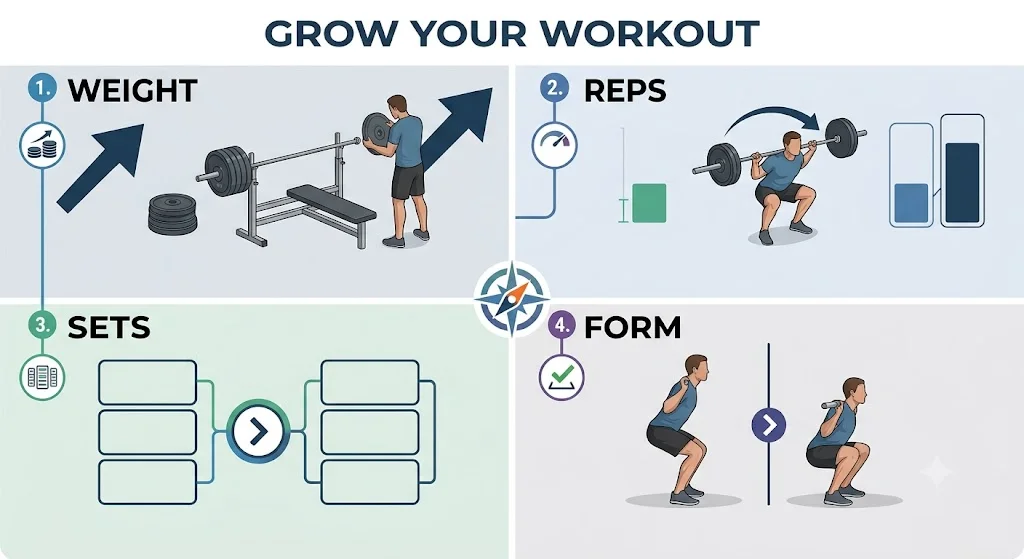
Progressive overload simply means gradually increasing the challenge placed on your body over time. That can happen by lifting more weight, performing more reps, doing more productive sets, improving your range of motion, or making an exercise more difficult.
You do not need to make every workout harder than the last one. In fact, forcing progression every single session is not realistic.
The goal is to give your body a reason to keep adapting.
What Is Progressive Overload?
Progressive overload is the gradual progression of training stress as your body adapts.
That idea is much simpler than the way it is sometimes explained online.
If you can comfortably perform an exercise with 10 kg today, your body may eventually adapt to that workload. Therefore, continuing to use exactly the same workload forever may not provide the same training challenge.
Progression gives you a way to keep moving forward.
The important word is gradually.
Progressive overload does not mean throwing another 10 kg onto the bar just because you had a good day.
Instead, it means increasing the challenge in a way that you can control and recover from.
The 2026 ACSM resistance-training position stand recommends progressive resistance training and emphasizes gradual progression as part of effective training for strength and muscle growth.
Progressive Overload for Beginners: Why Does It Matter?
Your body adapts to the demands you repeatedly place on it.
Imagine you start bench pressing 40 kg and perform 8 good reps. After several weeks of consistent training, that same workload may become easier.
That is progress.
However, the next step is not always “add more weight.”
You might first perform 9 or 10 reps with the same weight. Later, you could increase the weight and work your way back up through the rep range.
This creates a simple cycle:
Train → Adapt → Progress → Repeat
That process helps you continue developing strength and muscle rather than staying stuck at the same workload.
Progressive resistance training is also a core part of the current ACSM guidance for improving strength and muscle size.
How to Progressive Overload Without Complicating It
There are several ways to make an exercise more challenging.
1. Increase the Weight
This is the method most people think about first.
For example:
Week 1: 20 kg × 10 reps
Week 2: 22.5 kg × 10 reps
The increase does not have to be huge.
Small jumps are often easier to maintain because strength does not increase at the same speed forever.
2. Increase the Reps
You can also keep the same weight and perform more reps.
For example:
Week 1: 20 kg × 8 reps
Week 2: 20 kg × 9 reps
Week 3: 20 kg × 10 reps
Once you reach the top of your chosen rep range with good technique, increasing the weight becomes a logical next step.
This is often called double progression, and it is one of the simplest ways for beginners to track progress.
3. Increase Your Sets
Another option is adding a productive set.
For example:
Week 1: 3 sets
Week 4: 4 sets
More work can help increase training volume, although more is not automatically better. The extra work still needs to be recoverable and useful.
Current ACSM guidance highlights higher weekly training volume as an important factor for hypertrophy, with roughly 10 sets per muscle group per week presented as a general starting point for muscle growth.
4. Improve Your Technique or Range of Motion
Progress does not always have to show up as a heavier number.
A cleaner squat, more controlled dumbbell press, or fuller range of motion can make the exercise more demanding and improve the quality of your training.
That is especially useful when adding more weight would cause your technique to break down.
Progressive Overload Does Not Mean Adding Weight Every Workout
This is probably the biggest misunderstanding.
You do not need to increase the weight every time you enter the gym.
Some workouts will be better than others.
You may sleep badly, feel tired, have a stressful day, or simply have an off session. On those days, maintaining the same workload can be perfectly fine.
In fact, trying to force progression every workout can eventually damage your technique or recovery.
A better approach is to look at your progress over weeks and months, not one individual session.
For example, moving from:
60 kg × 8 reps
to:
60 kg × 12 reps
is progress even though the weight did not change.
Likewise, improving from a difficult 8 reps to 10 controlled reps is meaningful progression.
What Is the Best Rep Range for Progressive Overload?
There is no single magical rep number.
Different rep ranges can be useful depending on the exercise and your goal.
For muscle growth, moderate rep ranges are commonly used because they allow you to accumulate productive training volume. For strength, heavier loads are often useful.
The current ACSM guidance recommends heavier loads around 80% of one-repetition maximum (1RM) for strength-focused training, while higher weekly volume is emphasized for hypertrophy.
That does not mean you need to calculate your 1RM for every exercise.
A simple approach for beginners is to choose a sensible rep range and focus on gradually improving your performance while maintaining good form.
How to Track Progressive Overload
If you do not track your workouts, it becomes much harder to know whether you are actually progressing.
You do not need a complicated spreadsheet.
Write down:
Exercise
Weight
Reps
Sets
For example:
Dumbbell Bench Press
Week 1: 30 kg × 8, 8, 7
Week 2: 30 kg × 9, 8, 8
Week 3: 30 kg × 10, 9, 8
Week 4: 32.5 kg × 8, 8, 7
The numbers may look small, but that is exactly what progression often looks like in real life.
Small improvements add up.
Progressive Overload vs Progressive Resistance Training
You may see both terms online.
They are closely related, but progressive overload is the broader idea of gradually increasing the training challenge.
Progressive resistance training refers more specifically to progressing resistance-training demands through changes in load and other training variables.
In normal gym conversation, you will often hear people use “progressive overload” for the whole concept.
So when someone says:
“You need progressive overload to build muscle,”
they are essentially saying:
“Your training needs to continue challenging you as your body adapts.”
Common Progressive Overload Mistakes
Increasing Weight Before You Are Ready
Adding weight while your technique falls apart is not useful progression.
A heavier dumbbell is not automatically a better set.
Changing Everything at Once
You do not need to increase weight, reps and sets simultaneously.
Choose one variable to progress and keep the rest relatively stable.
Ignoring Your Form
If your range of motion becomes much shorter or you start using momentum to move the weight, the number on the stack may be misleading.
Training Harder Instead of Training Better
More effort is not always better.
Good programming includes enough hard work and enough recovery.
Changing Your Program Every Few Weeks
Progressive overload becomes much easier to track when you repeat key movements long enough to see improvement.
Your routine does not need to be constantly reinvented.
For a practical beginner routine, check out our Beginner Strength Training Routine.
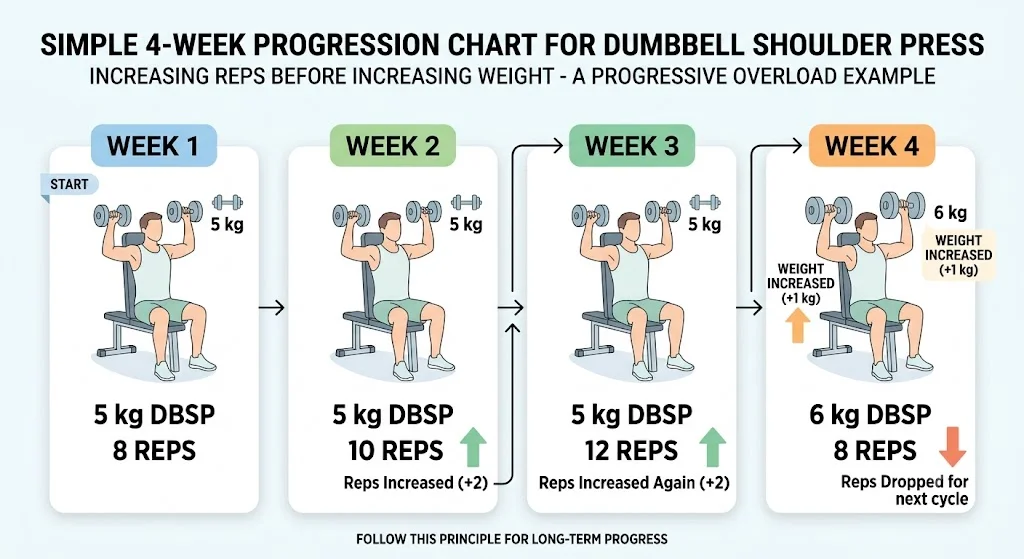
How to Progressive Overload a Workout: A Simple Example
Let’s say you are doing dumbbell shoulder presses in a 8–12 rep range.
Your starting point is:
Week 1: 20 kg × 8 reps
Week 2: 20 kg × 9 reps
Week 3: 20 kg × 10 reps
Week 4: 20 kg × 12 reps
Once 12 controlled reps become achievable, you could move to:
22.5 kg × 8 reps
Then you build the reps again.
That is progressive overload.
You did not need a revolutionary new exercise.
You simply made the same movement gradually more challenging.
Does Progressive Overload Build Muscle?
Progressive overload supports muscle growth because resistance training provides a stimulus that your body adapts to.
However, progression does not happen in isolation.
Adequate food, protein, sleep and recovery all matter.
That is why getting stronger on an exercise while consistently eating too little or recovering poorly may not produce the results you expect.
For nutrition, you can use our High Protein Indian Meals on a Budget guide, which also includes a protein-intake calculator.
You can also read Muscle Building Tips for Beginners for a broader look at training, nutrition and realistic muscle-building strategies.
FAQ About Progressive Overload
What is progressive overload in simple words?
Progressive overload means gradually making your training more challenging as your body adapts.
Do I need to increase weight every workout?
No. You can increase reps, sets or other training variables, and sometimes simply maintaining the same workload is appropriate.
Is progressive overload necessary to build muscle?
Some form of ongoing training progression is useful as your body adapts, but progression does not mean endlessly adding weight. Good resistance training also depends on sufficient volume, effort, recovery and consistency.
How often should I increase the weight?
There is no fixed schedule. Increase the load when you can complete your planned reps with good technique and still have room to progress.
Can beginners use progressive overload?
Absolutely. Beginners can start with very simple progression, such as adding one rep at a time and increasing the weight when they reach the top of their rep range.
What if I cannot increase the weight?
You can still progress by improving reps, technique, range of motion or sets. Progress does not stop just because the next dumbbell is too heavy.
Is progressive overload only for muscle building?
No. Progressive training can also support improvements in strength, power and physical performance. The exact way you progress depends on your goal.
Final Takeaway
Progressive overload is not about lifting the heaviest weight possible every time you enter the gym.
It is about gradually increasing the challenge as your body becomes stronger and more capable.
Sometimes that means more weight.
Sometimes it means another rep.
Sometimes it means another set or better technique.
The important part is that your training keeps moving forward while staying recoverable.
Track what you do. Focus on good technique. Make small improvements. Then repeat.
You do not need to reinvent your workout every Monday.
Progress beats randomness.