
Walk into a supplement store looking to gain muscle, and you will probably be shown two things first: whey protein and mass gainer.
Both can help support a muscle-building diet, but they are designed for different problems.
Whey protein mainly helps you reach your protein target. Mass gainer is designed to help you consume more total calories while also providing protein.
That difference is important.
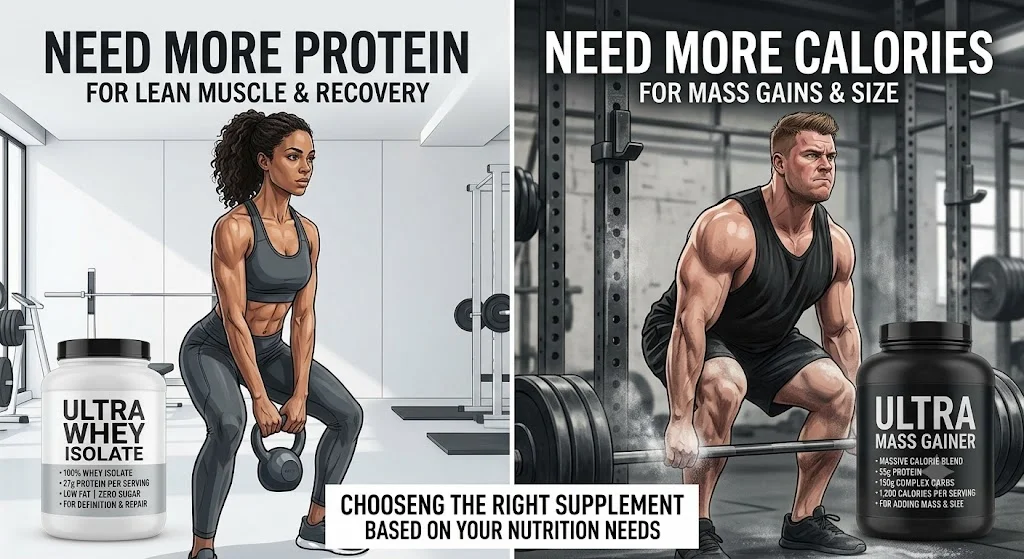
If you already eat enough calories but struggle to get enough protein, whey may make more sense. On the other hand, if you struggle to eat enough food to gain weight, a mass gainer can be a convenient way to increase your calorie intake.
The best choice is therefore not about which tub looks more impressive.
It is about what your diet is currently missing.
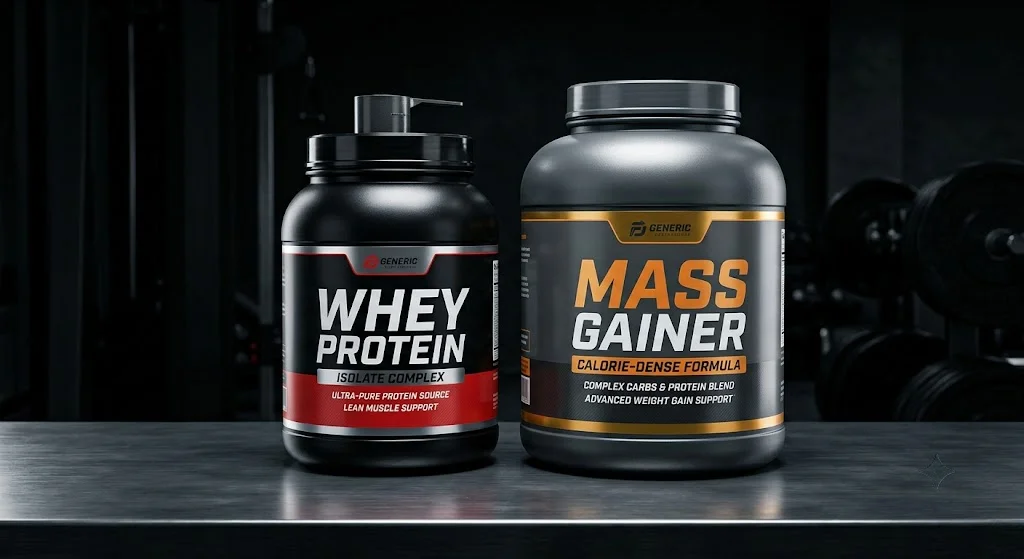
Whey Protein vs Mass Gainer: What Is the Difference?
The simplest way to understand the difference is to look at what each product is trying to provide.
Whey Protein
Whey is a protein-rich supplement made from milk. Its main purpose is to make it easier to consume enough protein without having to prepare another full meal.
A typical whey serving often provides around 20–30 g of protein with relatively few calories compared with a mass gainer, although the exact nutrition depends on the product.
The International Society of Sports Nutrition’s position stand on protein and exercise notes that about 1.4–2.0 g of protein per kilogram of body weight per day is sufficient for most exercising individuals.
So if your meals are already high in calories but your protein intake is falling short, whey is the more obvious tool.
Mass Gainer
Mass gainer is essentially a high-calorie supplement containing protein plus a large amount of carbohydrate, and some products also contain fat or additional ingredients.
The exact formula can vary dramatically between brands.
One serving may contain several hundred calories, while another may provide close to or above 1,000 calories depending on the serving size.
That makes a mass gainer useful for someone who has trouble eating enough total food.
However, it is important to understand what it actually does.
A mass gainer does not contain a special muscle-building ingredient that whey does not have. It mainly makes it easier to consume more calories and some protein.
Whey Protein vs Mass Gainer: Which Has More Calories?
This is where the biggest practical difference appears.
Whey protein is usually relatively low in calories compared with a full meal or mass gainer.
A mass gainer, by contrast, is intentionally calorie-dense.
For example, a whey serving might provide roughly:
20–30 g protein
100–150 calories
A mass gainer serving might provide:
25–50+ g protein
500–1,000+ calories
These are only examples. Always check the nutrition label because serving sizes and formulas vary considerably between products.
The important point is this:
Whey helps you add protein. Mass gainer helps you add protein and a lot more calories.
That makes the choice much easier.
Whey Protein vs Mass Gainer: Which Is Better for Muscle Gain?
Neither product automatically builds muscle better.
Your resistance training, total protein intake, calorie intake and recovery are the foundation.
Research supports adequate protein intake as an important part of resistance training, and protein supplementation can help when it increases total protein intake. A large meta-analysis found that protein supplementation enhanced gains in muscle size and strength during prolonged resistance training, with little additional benefit to fat-free mass once total protein intake exceeded roughly 1.6 g/kg/day. (PubMed)
Therefore, the supplement that solves your actual nutritional problem is the better choice.
If You Already Eat Enough Calories
Suppose you are eating enough to support your goal but your daily protein intake is low.
In that situation, whey makes more sense.
Adding another 500–800 calories through a mass gainer could simply push your calorie intake higher than necessary.
If You Struggle to Eat Enough Calories
Now imagine the opposite.
You eat plenty of protein, but you struggle to consume enough food to gain weight.
Your meals are filling. Your appetite disappears halfway through the day. You keep telling yourself you’ll eat more tomorrow.
In that situation, the extra calories from a mass gainer can be useful.
Nutrition reviews on gaining lean mass commonly discuss increasing energy intake and using energy-dense or liquid foods when eating enough becomes difficult. (PubMed review)
When Should You Choose Whey Protein?
Whey is usually the simpler choice when your main issue is protein.
It can make sense when:
- You struggle to reach your daily protein target
- You want a quick post-workout protein source
- Your normal meals are already providing enough calories
- You want something easy to carry
- You do not want a huge calorie increase
For example, someone eating eggs, dal, rice, roti, chicken and curd may already have enough total calories but still fall short of their desired protein intake.
A whey shake can fill that gap without dramatically changing the rest of the diet.
For practical Indian food options, see High Protein Indian Meals on a Budget.
That article also includes the SUPERASTIK Protein Intake Calculator, which can help you estimate a daily protein target based on body weight.
When Should You Choose a Mass Gainer?
A mass gainer becomes more useful when eating enough calories is the actual problem.
This is common among people with low appetites, very high activity levels or busy schedules.
Imagine you have already eaten breakfast, lunch and dinner, but you are still hundreds of calories short of your target.
Drinking a calorie-dense shake can be much easier than forcing yourself to eat another giant plate of rice and chicken.
That is one reason liquid calories can be useful during weight-gain phases. Research on intentional weight gain also discusses energy-dense foods and liquid nutrition as practical strategies when increasing food intake is difficult. (PubMed)
However, a mass gainer should not become an excuse to eat an enormous calorie surplus.
The goal is to gain useful body mass, not simply make the number on the weighing scale explode.
Can You Use Whey Instead of Mass Gainer?
Yes, but there is a catch.
You can turn whey into a high-calorie shake by adding calorie-dense foods such as:
- Milk
- Banana
- Oats
- Peanut butter
- Dates
- Yogurt
Now you have something that can provide both protein and plenty of calories.
In other words, you can build your own “mass gainer” at home.
For many people, this can be useful because you control the ingredients and serving sizes.
For example:
Whey + milk + banana + oats + peanut butter
can create a substantial shake without needing a commercial mass gainer.
This also makes it easier to adjust calories depending on your needs.
Is Mass Gainer Better for Skinny People?
Not automatically.
Being naturally thin does not mean you specifically need a mass gainer.
The real question is:
Are you struggling to eat enough calories to gain weight?
If yes, a mass gainer may be useful.
If no, you may simply need a normal calorie surplus from regular food and enough protein.
Likewise, someone with a large appetite may not need a mass gainer at all.
The supplement does not know whether you are “hardgainer” or “easy gainer.”
It is simply a convenient source of calories and protein.
Can Mass Gainer Make You Fat?
It can contribute to fat gain if it pushes your calorie intake significantly above what you need.
A calorie surplus can support increases in lean mass when paired with resistance training, but the ideal size of the surplus is not perfectly established and individual needs vary. (PubMed review)
That is why blindly drinking a massive serving every day is not a smart bulking strategy.
Start by looking at your body-weight trend.
If your weight is rising much faster than intended and your waist is increasing quickly, reduce your total calorie intake.
A mass gainer should make your diet easier, not turn it into a calorie competition.
Whey Protein vs Mass Gainer: Which Is More Budget-Friendly?
The answer depends on the product and how you use it.
Whey usually costs more per gram of protein than some whole foods, but it is convenient and relatively protein-dense.
Mass gainers provide far more calories per serving, but that does not necessarily make them better value for protein.
Therefore, compare the price per serving, protein per serving and calories per serving rather than simply looking at the tub price.
Also compare those costs with ordinary foods.
Eggs, milk, dal, soy chunks, curd and other staples can already provide substantial amounts of protein and calories.
Your supplement should solve a problem your normal diet cannot conveniently solve.
Whey Protein vs Mass Gainer: Can You Take Both?
Yes, but you may not need both.
If you already use whey and your diet provides enough calories, adding a mass gainer may simply duplicate what you are already doing while pushing calories unnecessarily high.
On the other hand, someone who needs both more protein and more calories could use whey for one purpose and a calorie-dense shake for another.
The key is to look at the whole diet.
For a broader explanation of whey, creatine and pre-workout, check out Whey, Creatine & Pre-Workout Explained.
What Should Beginners Buy First?
For most beginners, I would not rush straight to a mass gainer.
First, work out what your diet is missing.
If Protein Is the Problem
Choose whey protein.
If Calories Are the Problem
Consider a mass gainer or simply a homemade calorie-dense shake.
If Neither Is the Problem
You probably do not need either one.
That is worth remembering.
Supplements are supposed to make your diet easier, not make your diet more complicated.
If you are still building your training foundation, our Beginner Strength Training Routine is a better place to spend your attention than obsessing over which tub to buy.
Common Mistakes When Choosing Between Whey and Mass Gainer
Choosing Based on the Biggest Number on the Label
A mass gainer advertising 1,000 calories may look impressive.
However, more calories are not automatically better.
Using a Mass Gainer Without Tracking Your Diet
If you already eat enough, adding a huge shake can make your calorie surplus unnecessarily large.
Thinking Whey Is Only for Bodybuilders
Whey is simply a convenient protein source. You do not need to be a competitive bodybuilder to use it.
Replacing Too Many Meals With Shakes
Liquid nutrition can be useful, but whole foods still provide a wider range of nutrients and can be an important part of a balanced diet.
Buying a Supplement Before Understanding Your Goal
First identify whether you need more protein, calories, or neither.
Then choose the tool.
FAQ About Whey Protein vs Mass Gainer
Is whey protein better than mass gainer?
Neither is universally better. Whey is better suited to increasing protein intake, while mass gainer is more useful when you need substantially more calories as well.
Which is better for bulking?
Both can fit into a bulk. The better choice depends on whether your main limitation is protein intake or total calorie intake.
Can whey protein make you gain weight?
Yes, if it increases your total calorie intake enough. Whey itself does not automatically cause weight gain.
Can I gain muscle without mass gainer?
Absolutely. A mass gainer is optional. Regular food can provide both protein and calories when your diet is planned appropriately.
Is mass gainer necessary for skinny people?
No. It can be useful for people who struggle to eat enough calories, but being skinny by itself does not create a requirement for a mass gainer.
Can I make my own mass gainer?
Yes. A homemade shake using whey, milk, oats, banana and peanut butter can provide protein plus a substantial amount of calories.
Should I take whey if I already eat enough protein?
You do not need to. Whey is mainly useful for convenience when food intake does not easily cover your protein needs.
Does mass gainer build more muscle than whey?
Not by itself. Muscle growth depends on resistance training, sufficient protein, overall energy intake and recovery. A mass gainer mainly makes it easier to consume more calories.
Final Takeaway
The whey protein vs mass gainer decision is actually pretty simple.
Choose whey when protein is your problem.
Choose mass gainer when calories are your problem.
And when your regular diet already covers both, you may not need either one.
Whey is a convenient protein source. Mass gainer is a convenient way to add a lot of calories while also getting some protein.
Neither supplement replaces proper training, nutrition or recovery.
So before buying the biggest tub on the shelf, ask yourself one question:
What is my diet actually missing?
Once you know that, the choice becomes much easier.
One Response