
Starting the gym can feel surprisingly complicated.
You walk in and see machines you have never touched, people lifting weights that look heavier than your entire personality, and someone doing an exercise you’ve never even heard of.
Relax.
Your first month does not need to be about becoming the strongest person in the room. It is about learning the basics, building consistency, and creating a routine you can actually follow.
This beginner gym checklist covers what to bring, what to do during your workouts, what to track, what to eat, and the mistakes that can make your first month harder than it needs to be.
Beginner Gym Checklist: What Should You Bring?
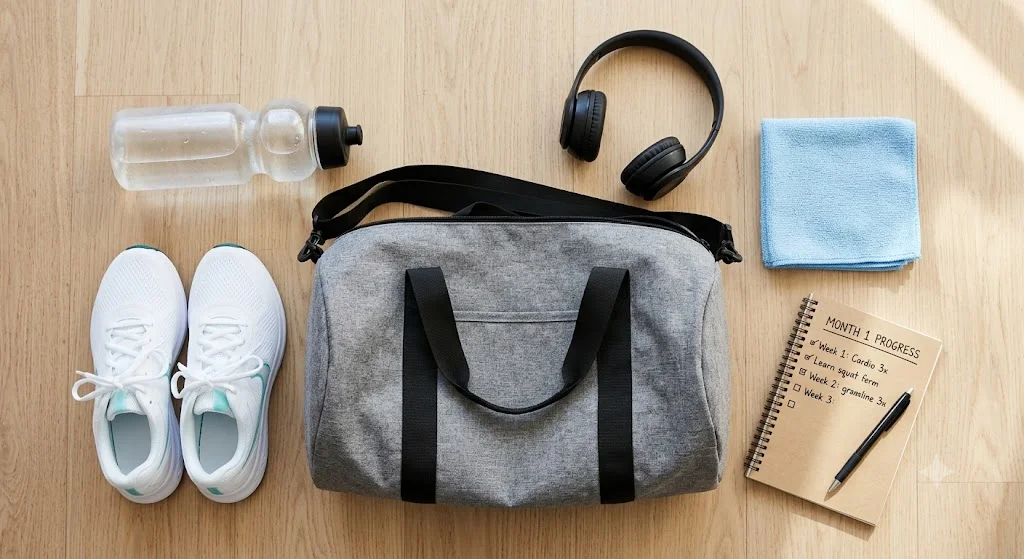
You do not need a giant gym bag full of gadgets.
For your first month, keep it simple.
The Essentials
Training shoes
Wear stable, comfortable shoes that allow you to train safely and move naturally.
Water bottle
Staying hydrated during training is a simple habit worth building.
Small towel
Useful for wiping equipment and keeping yourself comfortable.
Gym clothes
Choose clothes that let you move freely rather than worrying about looking like a professional bodybuilder.
Phone or workout notebook
Use it to record exercises, weights, reps, and sets.
Optional: headphones, lifting straps, a belt, or other accessories can come later if you actually need them.
The gym does not require a suitcase.
Beginner Gym Checklist: What Should You Do Before Your First Workout?
The first thing to decide is what you are training for.
Do you want to build muscle? Get stronger? Lose fat? Improve general fitness?
Your goal affects your training and nutrition choices.
Next, decide how many days you can realistically train.
Do not promise yourself six gym sessions every week if your schedule only allows three.
The current ACSM resistance-training guidance emphasizes choosing a routine that fits your schedule, comfort level and goals because consistency drives long-term results. The same guidance recommends training all major muscle groups at least twice per week as a general starting point. (acsm.org)
For general health, the CDC recommends adults do muscle-strengthening activity on at least two days each week. (cdc.gov)
You do not need a perfect plan before you start.
You need a realistic one.
What Should You Do During Your First Month?
Your first month should be about learning.
Focus on basic movement patterns and becoming comfortable with the equipment.
A beginner routine might include:
- Squat or leg press
- Bench press or chest press
- Lat pulldown
- Row
- Shoulder press
- Hip hinge movement
- A simple biceps exercise
- A simple triceps exercise
- Basic core work
You do not need twelve different exercises for every muscle.
Instead, learn a smaller number of movements properly and gradually improve.
If you need a ready-made starting point, check out our Beginner Strength Training Routine.
Beginner Gym Checklist: How Many Days Should You Train?
Three days per week is a perfectly reasonable starting point for many beginners.
For example:
Monday: Full Body
Wednesday: Full Body
Friday: Full Body
You could also train four days if your schedule allows and your recovery is good.
The important thing is not to copy a professional bodybuilder’s schedule during your first month.
A routine you can repeat is more valuable than a complicated plan you abandon after two weeks.
Once you understand the basics, you can experiment with different structures. Our PPL vs Bro Split guide explains how different splits fit different schedules.
How Hard Should Beginners Train?
This is another area where beginners often go too far.
Your goal is not to turn every set into a life-or-death event.
Use a weight that allows you to maintain good technique while making the final repetitions challenging.
As you become more comfortable, you can gradually increase the challenge.
That is the basic idea behind progressive overload.
You might add:
more reps
or
a small amount of weight
or
another productive set
or improve your technique and range of motion.
The current ACSM guidance emphasizes gradually building training demands rather than relying on unnecessarily complicated methods. (acsm.org)
Beginner Gym Checklist: What Should You Track?
Tracking your workouts is one of the easiest ways to know whether you are improving.
Write down:
Exercise
Weight
Reps
Sets
For example:
Dumbbell Bench Press
Week 1: 20 kg × 8, 8, 7
Week 2: 20 kg × 9, 8, 8
Week 3: 20 kg × 10, 9, 9
That is progress.
You do not need to increase the weight every workout. Your goal is to gradually improve your performance over time.
A simple record also helps you avoid wandering around the gym wondering what you did last Tuesday.
What Should Beginners Eat?
Training is only one part of the equation.
Your body also needs enough food and protein to support your goal.
If your goal is muscle growth, aim for a consistent diet containing enough protein, carbohydrates, fats, fruits and vegetables.
For exercising individuals, sports nutrition guidance commonly recommends around 1.4–2.0 g of protein per kilogram of body weight per day. (ISSN protein position stand)
You do not need to live on chicken and protein shakes.
Eggs, dal, milk, curd, soy chunks, chana, paneer, chicken, rice and roti can all fit into a useful muscle-building diet.
Our High Protein Indian Meals on a Budget guide has practical Indian meal ideas and also includes a protein-intake calculator.
And when your normal meals are not enough to cover your protein needs, Whey Protein vs Mass Gainer explains when each supplement actually makes sense.
Beginner Gym Checklist: What Should You Ignore?
The first month is also about learning what not to worry about.
You Do Not Need a Huge Supplement Stack
You can make excellent progress without taking five different powders.
Build your training and diet first.
You Do Not Need to Train Every Day
Recovery is part of training.
More gym days do not automatically mean more results.
You Do Not Need to Copy Influencers
Your favourite fitness creator may have a completely different training history, body weight, schedule and goal.
Their routine may not be appropriate for you.
You Do Not Need Perfect Technique on Day One
Learn the movement.
Improve your technique.
Ask a qualified trainer for help when you are unsure.
Then keep practicing.
You Do Not Need to Lift the Heaviest Weight in the Gym
Your first month is not a strength competition.
A lighter weight with controlled technique is much more useful than a heavier weight that you cannot control.
Beginner Gym Checklist: Your First 30 Days
Here is a simple roadmap.
Week 1: Learn
Start by getting familiar with the gym layout and the equipment around you. Take some time to learn how the machines are adjusted and where everything is located.
Next, focus on understanding the basic exercises in your program. Ask a trainer for help when you are unsure about a movement or piece of equipment.
Do not worry about lifting huge weights during your first week. The goal is to become comfortable, learn proper technique, and build a routine you can repeat.
Week 2: Build Your Routine
Start becoming more consistent.
Try to arrive at roughly the same times on your training days.
Track every workout.
Week 3: Start Progressing
Compare your current performance with your first week.
Can you perform another rep?
Can you use slightly more weight?
Is your technique improving?
Those are signs that your training is moving forward.
Week 4: Review
Look at your first month as a whole.
Which exercises improved?
Did you miss many sessions?
Are you recovering well?
Is your body weight moving in the direction you want?
What should you change next month?
Do not completely rebuild your program just because one workout felt bad.
Common First-Month Gym Mistakes
Doing Too Much Too Soon
Your enthusiasm may be high.
Your recovery capacity may not be.
Start with manageable training and build gradually.
Changing Your Program Every Week
Give your routine enough time for you to judge whether it is working.
Ignoring Sleep and Recovery
Training creates the stimulus, but recovery supports adaptation.
Only Training Your Favourite Muscles
Do not build a routine around chest and biceps while treating legs and back like optional DLC.
Train the major muscle groups.
Comparing Yourself to Experienced Lifters
Someone who has trained for five years will not look or perform like someone who started five weeks ago.
That comparison is useless.
Measure yourself against your own starting point.
What Should You Focus on After Your First Month?
By the end of your first month, you should have a basic understanding of your main exercises, workout tracking, training intensity, and gradual progression.
Your nutrition should also make more sense for your current goal.
From there, you can start refining your program.
More training volume might be useful if your current workload is too low. A different training split could suit your schedule better. Your nutrition may also need adjustment depending on your progress and goal.
The important thing is to make changes based on your actual results rather than changing everything at once.
FAQ About the First Month at the Gym
How many days should a beginner go to the gym?
Three days per week is a practical starting point for many beginners. Some people can comfortably train four days, while others may start with two. The best schedule is one you can consistently follow.
What should I bring to the gym?
Bring comfortable training clothes, suitable shoes, water, and a small towel. A phone or notebook for tracking your workouts is also useful.
Should beginners use supplements?
Not necessarily. Build your training and diet first. Supplements can be useful when they solve a specific nutritional problem.
Should I train to failure as a beginner?
You do not need to take every set to absolute muscular failure. Focus on good technique and challenging but controlled sets. The current ACSM guidance does not identify training to momentary failure as essential for the average healthy adult. (acsm.org)
What exercises should beginners do?
Start with basic movement patterns that train the major muscle groups. A simple full-body routine is often easier to learn and manage than a complicated bodybuilding program.
How quickly will I see results?
Strength can improve relatively quickly when beginners learn the movements and become more coordinated. Visible changes in muscle and body composition usually take longer and depend on training, nutrition, recovery, and individual factors.
Do I need to train every muscle twice a week?
Training major muscle groups at least twice weekly is a useful general starting point in current ACSM guidance, but the exact structure should fit your schedule and training level. (acsm.org)
Final Takeaway
Final Takeaway
Your first month at the gym is not about becoming an expert.
Instead, focus on becoming consistent.
Learn the exercises. Keep track of your workouts. Use sensible weights and gradually improve your performance.
There is no need for the perfect split, a huge supplement stack, or the fanciest gym bag. What matters most is having a routine that fits your life and allows you to keep showing up.
Give yourself time to learn, adapt, and improve.
Show up. Learn. Progress. Repeat.