
Most people build muscle and strength well with three to four gym days a week. Two days can work when life is busy, and five or six days can work too, but more is not automatically better.
So, how many days a week should you go to the gym? The honest answer depends on your goal, your recovery, and how consistently you can show up. This guide explains what research says about gym frequency and then gives simple weekly plans you can start with.
The Short Answer: How Many Gym Days a Week?
Use this table as a starting point, not a rulebook.
| Your situation | Gym days per week | Simple setup |
|---|---|---|
| Complete beginner | 3 | Full-body workouts on non-consecutive days |
| Very busy schedule | 2 | Two full-body sessions |
| Building muscle (most people) | 3–4 | Full body or upper/lower split |
| Intermediate lifter wanting more volume | 4–5 | Upper/lower or push-pull-legs |
| Experienced lifter with good recovery | 5–6 | Push-pull-legs or a similar split |
Consistency matters more than the perfect number. A plan you can follow for six months will beat an ambitious schedule that falls apart in three weeks.
How Often Should You Train? What Research Says
Health guidelines set the minimum. The WHO recommends muscle-strengthening activities involving the major muscle groups on two or more days a week for adults. Meanwhile, a table comparing major physical activity guidelines lists ACSM advice to train each major muscle group two to three days a week.
For building muscle specifically, a 2016 meta-analysis of studies with matched volume found that training a muscle twice a week produced better growth than training it once. The authors concluded that major muscle groups should be trained at least twice a week, although they could not say whether three times beats two.
However, later research complicates the picture. Training volume simply means the number of hard sets you do for a muscle across the week. A review of studies using direct measures of muscle growth concluded that, when volume is equal, training frequency does not seem to have a pronounced effect on muscle gain. In other words, the total amount of quality work per muscle matters more than how many days you spread it across.
More days also does not guarantee more growth. One six-week trial of 27 resistance-trained men found that training three times or six times per week produced similar results when volume was matched. Of course, the study was small and short, so it cannot settle the debate on its own.
Put simply, train each muscle about twice a week, then pick the number of gym days that lets you do that comfortably.
Best Gym Schedule by Experience Level
Beginners: 3 Days a Week
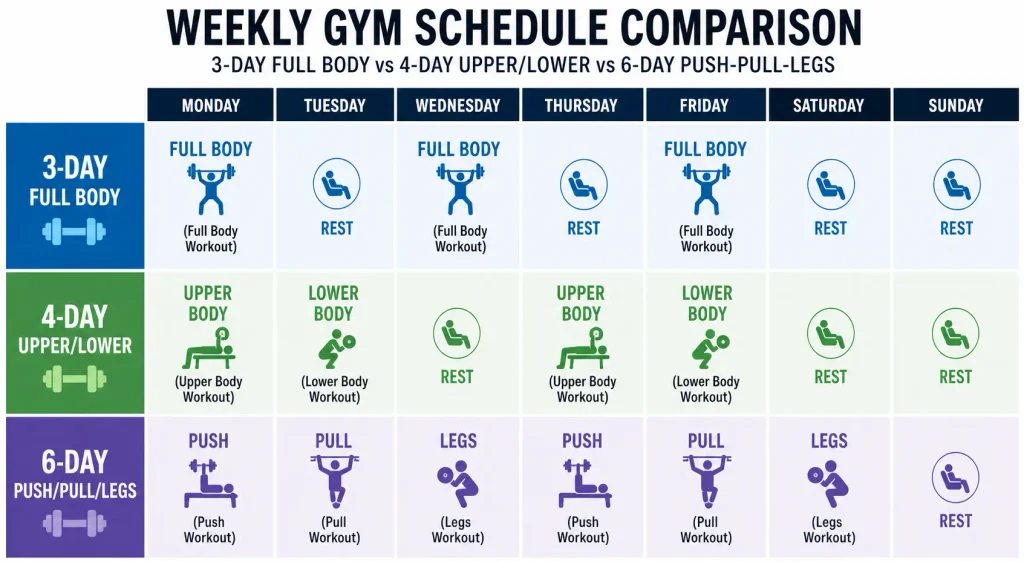
Three full-body sessions, for example Monday, Wednesday, and Friday, train every major muscle at least twice a week while leaving a rest day between workouts. Our beginner strength training routine lays out the exercises, sets, and reps. Also, the beginner gym checklist covers what to focus on during your first month.

Busy Lifters: 2 Days a Week
Two full-body sessions meet the WHO minimum and can still improve strength, especially if you are new to lifting. Progress may be slower than with three days. Even so, a consistent two-day plan beats a six-day plan you abandon after a month. To get the most from each session, add weight or reps gradually, as explained in our guide to progressive overload.
Four Days: Upper/Lower Split
An upper/lower split might look like this: upper body on Monday, lower body on Tuesday, rest on Wednesday, upper on Thursday, lower on Friday. Each muscle gets trained twice, and individual sessions stay shorter than a full-body workout with many exercises. This setup suits you once three full-body days start feeling too long or too crowded.
Five or Six Days: Push-Pull-Legs
Running push, pull, and legs twice through takes six days, while a five-day version fits in an extra rest day. This approach works for experienced lifters who recover well and enjoy longer training weeks. It is not required for good results, though. If you are deciding between this and a body-part split, our comparison of PPL vs bro split breaks down who each one suits.
Can You Go to the Gym Every Day?
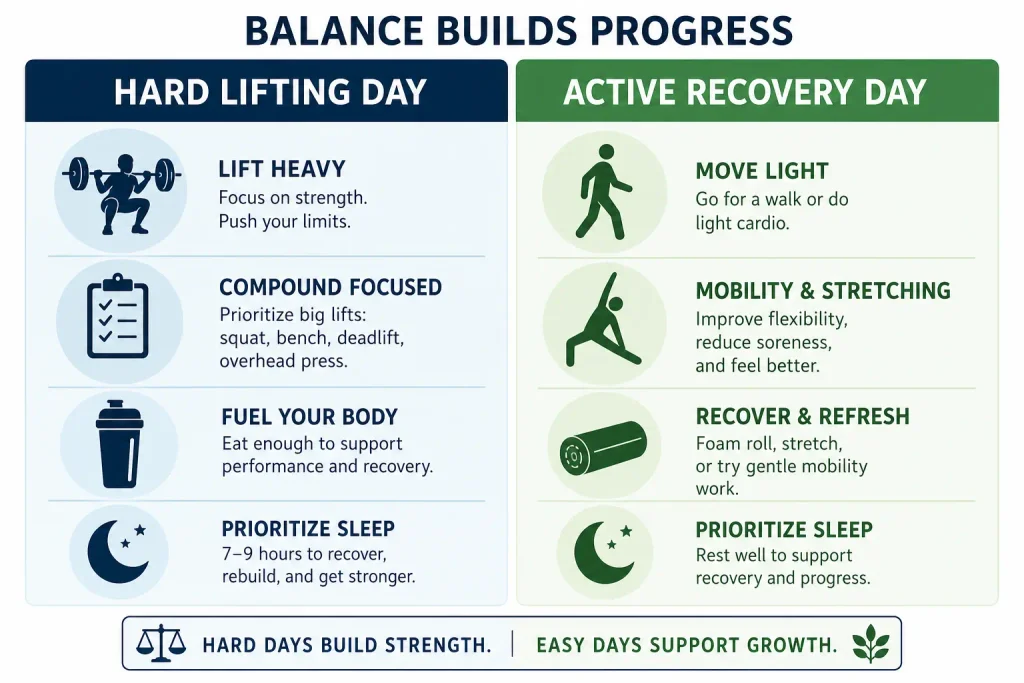
You can stay active every day, but hard weight training every single day is rarely necessary. Muscles need time between demanding sessions, and sleep, food, and stress all affect how well you recover. Training daily on too little sleep or protein can leave you tired and stuck rather than stronger.
If you want to be in the gym daily, alternate hard lifting days with lighter activity such as walking, mobility work, or easy cardio. Eating enough protein also supports recovery, and our guide on getting 100g of protein a day on an Indian budget shows how to do it without overspending.
How to Choose the Right Number of Gym Days
Start with the schedule you can realistically keep for the next three months. College, work, and commute times all matter here, so a plan that needs six early mornings a week may not survive exam season or a busy quarter.
Next, watch your recovery. Persistent fatigue, poor sleep, or workouts that keep getting worse suggest you are doing too much for now. Finally, consider your goal. If you want general fitness, two to three days is plenty, while chasing faster muscle growth may justify four or five days once your basics are in place. For the bigger picture, see our muscle building tips for beginners.
Common Mistakes When Choosing Gym Days
- Jumping from zero to six days. Your body and your habits both need time to adapt.
- Hitting the same muscle hard on back-to-back days. Spread similar workouts apart so each muscle can recover.
- Copying an influencer’s split. Their schedule reflects their recovery, genetics, and lifestyle, not yours.
- Skipping rest days. Rest is part of the plan, not a reward for finishing it.
- Changing the plan every week. Staying with one routine long enough to progress teaches you far more than constant switching.
FAQ
Is going to the gym 3 days a week enough?
Yes, for most people. Three well-planned full-body sessions train every muscle at least twice a week, which matches both health guidelines and the research above.
Is 2 days a week enough to see results?
It can be, particularly for beginners. Results may come more slowly, but two focused sessions a week are far better than none.
How many rest days do I need?
Most plans include at least one or two days without hard lifting. The exact number varies with your experience, sleep, and how demanding your sessions are.
Is 6 days a week too much for a beginner?
Usually, yes. Beginners can make strong progress on three or four days, so there is little reason to rush into a six-day routine.
Final Takeaway
For most people, three to four gym days a week is the sweet spot. Two days still counts when life gets busy, and five or six days only makes sense when recovery keeps up. Aim to train each muscle about twice a week, then choose the schedule you can repeat for months. Over time, steady effort will always outperform an impressive plan you cannot maintain.

0 COMMENTS