
Creatine is one of the most popular supplements in the fitness world. At the same time, it is surrounded by a ridiculous number of questions.
How much should you take? Do you need to load? Should you take it before your workout? Does it cause weight gain? What about hair loss? And, most importantly, is creatine actually worth taking?
The good news is that creatine for beginners is much simpler than supplement marketing makes it look.
For most healthy adults who do resistance training, creatine monohydrate is the form with the strongest evidence. A simple daily dose can support high-intensity exercise performance and, when combined with resistance training, help improve gains in strength and lean mass over time. (ISSN creatine position stand)
This guide explains exactly how creatine works, how much to take, when to take it, what to expect, and what beginners should know before buying their first tub.

What Is Creatine?
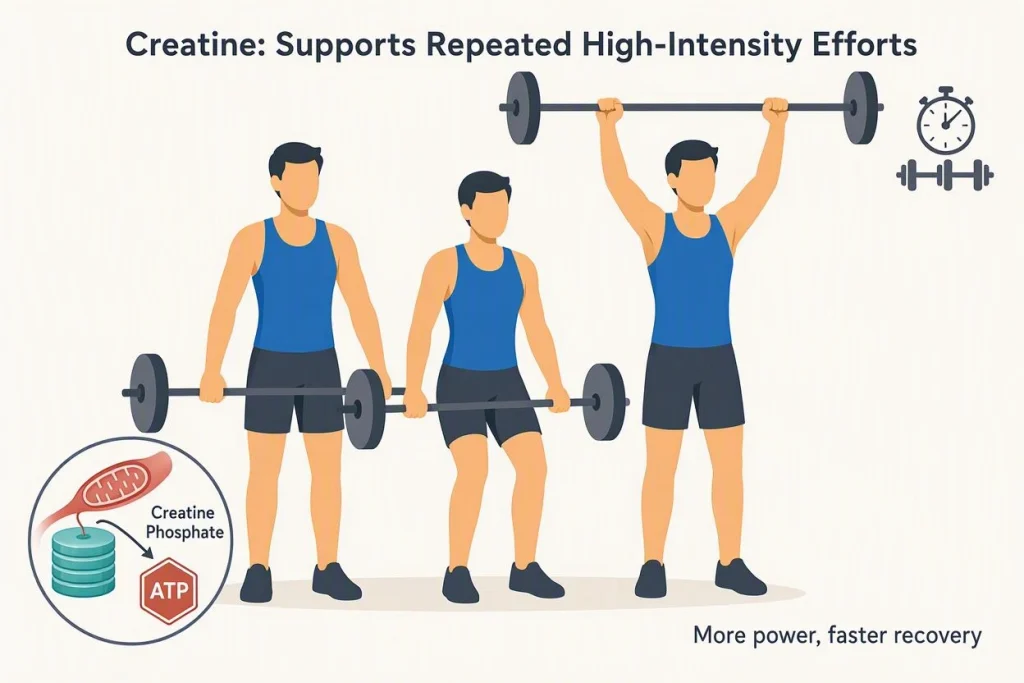
Creatine is a naturally occurring compound found in your body and in foods such as meat and fish. Most of it is stored in skeletal muscle, where it helps your body rapidly produce energy during short, high-intensity efforts.
That is why creatine is particularly relevant to activities such as weight training, sprinting, and other repeated bursts of intense exercise.
When you supplement with creatine, your muscle stores can increase. As a result, you may be able to perform better during repeated high-effort sets and accumulate more useful training work over time.
A simple way to think about it is this:
Protein provides the building material. Creatine helps support high-intensity training performance.
The two are not replacements for each other.
Creatine Benefits for Beginners
Creatine is not an energy drink. You should not expect a sudden rush after taking it.
Instead, its benefits develop as muscle creatine stores increase and you continue training.
Research has found that combining creatine supplementation with resistance training can improve strength and lean-mass outcomes compared with training alone. Recent meta-analyses have reported improvements in both upper- and lower-body strength, although the size of the benefit varies between people and studies. (2025 systematic review and meta-analysis)
For a beginner, the practical benefits can include:
- Better support for repeated high-intensity efforts
- Potential improvements in strength and training performance
- Support for increases in lean mass when combined with resistance training
- A convenient, well-studied supplement that does not require complicated timing
However, creatine does not replace progressive training, adequate food, or recovery.
For the training side of muscle growth, read our Beginner Strength Training Routine.
Creatine for Beginners: How Much Should You Take?
This is probably the easiest part.
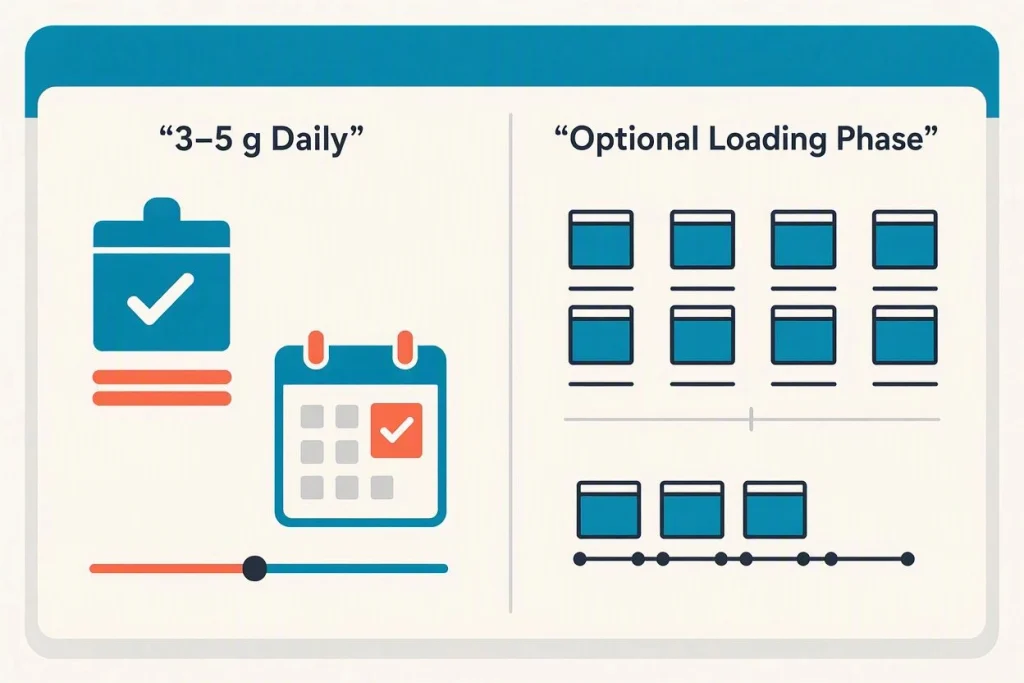
For everyday use, a common maintenance dose is 3–5 g of creatine monohydrate per day. The International Society of Sports Nutrition and other sports-nutrition resources describe this range as a standard approach for maintaining elevated muscle creatine stores. (ISSN creatine position stand; NIH Office of Dietary Supplements)
You do not need to calculate your daily dose based on every kilogram of body weight.
A simple routine works:
Workout day: 3–5 g
Rest day: 3–5 g
Morning or evening: Either is fine
Consistency is more important than trying to find a magical time of day.
Do Beginners Need a Loading Phase?
No.
A loading phase is optional.
One commonly studied approach is around 20 g per day for 5–7 days, divided into smaller servings, followed by 3–5 g per day. Loading can saturate muscle creatine stores faster, but taking 3–5 g every day without loading works too. (NIH Office of Dietary Supplements)
For most beginners, skipping the loading phase makes the routine easier.
When Should You Take Creatine?
You will see plenty of arguments about taking creatine before or after your workout.
The reality is much less dramatic.
There is not strong evidence that beginners need to take creatine at one exact time around their workout. The more important factor is taking it consistently enough to keep muscle creatine stores elevated. (ISSN nutrient timing position stand)
So choose the time you are least likely to forget.
You could take it with breakfast. Another option is adding it to your post-workout shake. Taking it with another daily meal works as well.
In other words:
Perfect timing is less important than perfect consistency.
You can also take creatine on rest days because the goal is to maintain elevated muscle stores rather than create an immediate effect from one serving.
Does Creatine Make You Gain Weight?
It can.
That sounds alarming until you understand what is happening.
Creatine supplementation can increase water stored within muscle, especially during the early stages of use. Therefore, the number on the scale may rise without that increase representing body fat.
Recent research also shows that creatine combined with resistance training can increase lean mass and body mass without a corresponding increase in fat mass. (2025 systematic review and dose-response meta-analysis)
So if your body weight increases after starting creatine, do not immediately assume that you gained fat.
Look at the bigger picture:
Body weight + waist measurement + gym performance + progress photos + diet
Those measurements tell you much more than one number on the scale.
This is especially useful for people who are deliberately trying to gain muscle. Our Muscle Building Tips for Beginners guide explains how training, nutrition, and recovery work together.
Is Creatine Safe?
Creatine monohydrate has been studied extensively in healthy adults, and commonly used doses have a strong safety record.
However, one detail often causes confusion: creatine supplementation can increase serum creatinine, a blood marker commonly used when assessing kidney function.
A 2026 systematic review and meta-analysis found that creatine increased serum creatinine but did not find significant changes in kidney filtration when assessed using a more direct marker. The researchers noted that the creatinine increase may reflect creatine metabolism rather than kidney damage. (2026 kidney-health systematic review and meta-analysis)
That does not mean creatine is appropriate for absolutely everyone.
People with known kidney disease or other medical conditions should discuss supplementation with a qualified healthcare professional first. It is also useful to tell your doctor that you take creatine if you have blood tests involving kidney function.
For healthy adults, the evidence remains generally reassuring at standard doses, but individual medical circumstances matter.
Does Creatine Cause Hair Loss?
This question has been floating around fitness forums for years.
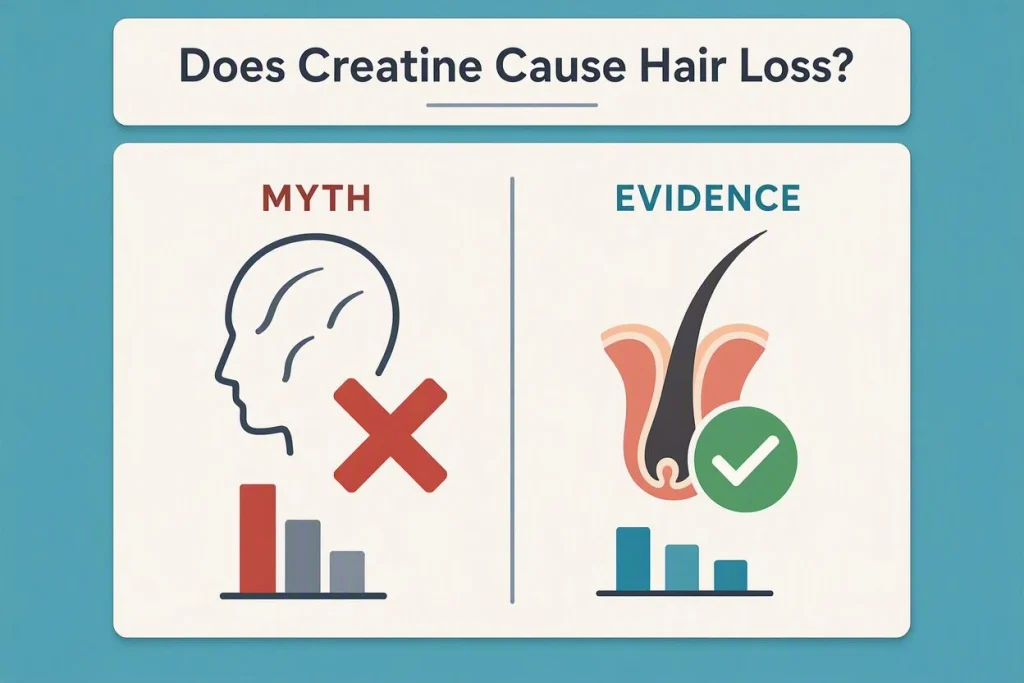
The concern mainly came from earlier research involving dihydrotestosterone, or DHT, a hormone associated with androgen-related hair loss.
However, a 2025 randomized controlled trial directly examined hair-related outcomes in resistance-trained young men taking 5 g of creatine per day for 12 weeks. The researchers found no significant differences between the creatine and placebo groups in DHT levels or measured hair outcomes. (2025 randomized controlled trial)
That study does not answer every possible question about hair loss for every person, but it provides direct evidence against the simple claim that standard creatine supplementation automatically causes hair loss.
So you do not need to treat every creatine tub like a secret appointment with a hair transplant clinic.
Which Creatine Should Beginners Buy?
The supplement shelf can make creatine look more complicated than it is.
You may see creatine monohydrate, creatine hydrochloride, buffered creatine, and other variations.
For beginners, creatine monohydrate is the straightforward choice because it has the largest research base and is generally inexpensive.
The NIH Office of Dietary Supplements notes that there is not convincing evidence that newer forms provide superior benefits over creatine monohydrate. (NIH Office of Dietary Supplements)
What Should You Check on the Label?
Look for:
- Creatine monohydrate
- Clear serving size
- Manufacturer information
- Batch and expiry information
- Proper packaging
- A reputable seller
You do not need a colourful formula containing ten different ingredients.
Plain creatine monohydrate does the job.
For a broader guide covering whey, creatine and pre-workout together, see Whey, Creatine & Pre-Workout Explained.
Can You Take Creatine With Whey Protein?
Yes.
There is no need to separate whey protein and creatine.
You can mix creatine into your whey shake, water, or another drink. Doing both together can actually make the routine easier to remember.
The important distinction is that whey and creatine have different jobs.
Whey: helps you reach your daily protein intake.
Creatine: supports high-intensity exercise performance and training adaptations.
When your normal diet already provides enough protein, you may not need whey. Likewise, taking creatine does not mean you suddenly have a balanced diet.
For practical food-based protein ideas, check our High Protein Indian Meals on a Budget article.
Common Creatine Mistakes Beginners Make
Taking Creatine Only on Workout Days
Creatine is normally used consistently every day.
Skipping rest days simply makes the routine less consistent.
Taking More Than You Need
A larger scoop does not automatically produce larger results.
For routine use, 3–5 g per day is enough for the standard maintenance approach.
Expecting an Instant Energy Boost
Creatine is not caffeine.
You should not expect the immediate buzz you might get from coffee or a stimulant-based pre-workout.
Panicking When the Scale Moves Up
Early weight gain can happen because of increased water stored in muscle.
Therefore, use multiple progress markers rather than judging creatine by the scale alone.
Ignoring Your Training
Creatine works alongside training.
It cannot replace progressive resistance training, adequate nutrition, or recovery.
Creatine for Beginners: The Simple Routine
Want the entire article reduced to one routine?
Here it is.
Every day:
Take 3–5 g of creatine monohydrate.
Workout day:
Take it whenever it is convenient.
Rest day:
Take it as usual.
Loading phase:
Optional.
Perfect timing:
Not necessary.
Fancy creatine formula:
Usually unnecessary.
That is basically it.
The boring routine is often the routine you can actually maintain.
FAQ About Creatine for Beginners
Is 5 g of creatine a day enough?
For most adults using creatine monohydrate, 3–5 g per day is a commonly used maintenance dose. (ISSN creatine position stand)
Do I need to load creatine?
No. A loading phase can increase muscle creatine stores faster, but taking 3–5 g every day without loading also works. (NIH Office of Dietary Supplements)
Should I take creatine before or after my workout?
Exact timing isn’t the main priority. Consistent daily use matters more than finding a perfect pre- or post-workout window.
Can I take creatine on rest days?
Yes. Continue your daily routine on rest days.
Does creatine make you fat?
Creatine can increase body weight because of increased water stored in muscle. That is not the same thing as gaining body fat. (pubmed.ncbi.nlm.nih.gov)
Is creatine a steroid?
No. Creatine is not an anabolic steroid. It is a naturally occurring compound involved in the body’s energy system.
Can creatine cause hair loss?
Current direct evidence does not show that standard creatine supplementation causes hair loss. A 2025 randomized controlled trial found no significant differences in DHT or measured hair outcomes between creatine and placebo groups. (pubmed.ncbi.nlm.nih.gov)
Can I mix creatine with whey?
Yes. Taking them together is completely practical.
Is creatine safe for everyone?
No supplement is appropriate for every person. People with kidney disease or other relevant medical conditions should discuss creatine use with a qualified healthcare professional before starting.
Final Takeaway
Creatine does not need to be complicated.
For beginners, creatine monohydrate is the simple, well-researched choice. A daily dose of 3–5 g is a common maintenance approach, and you do not need a loading phase or a perfectly timed scoop to benefit. (ISSN creatine position stand)
It can support high-intensity training performance and, when combined with resistance training, contribute to improvements in strength and lean mass. At the same time, early changes on the scale can reflect increased water stored in muscle rather than body-fat gain. (pubmed.ncbi.nlm.nih.gov)
Most importantly, remember what creatine is:
A supplement, not a shortcut.
Your training, food, and recovery still do the heavy lifting.
Creatine can support a good plan. It cannot create one for you.